
Risk disclosure: This guide is for education and information only and is not financial advice. Elysium and Montra were newly launched when this article was reviewed on November 11, 2026. Network settings, contracts, exchange support, fees and token data can change rapidly. Verify every action through official sources and on-chain records.
Elysium is a high-performance Arbitrum Orbit Layer 2 developed by Kinetiq that settles on HyperEVM and uses HYPE for gas. Montra is a permissionless token launchpad and Uniswap v4 trading venue built on Elysium. MONTRA is Montra’s native token, designed to be bought back and burned with 70% of Montra’s protocol fee share after activation. Users can trade MONTRA on Montra and, after confirming live availability, through HiBT’s MONTRA/USDT market.
Key Takeaways
- Elysium, Montra and MONTRA are three different things: network, application and token.
- Elysium launched mainnet on November 9, 2026 and uses HYPE—not MONTRA or KNTQ—as gas.
- Montra launches a token, its Uniswap v4 pool, locked initial liquidity and an optional first buy in one atomic transaction.
- Montra does not use a bonding curve or require liquidity migration. “Graduation” is a milestone inside the original pool.
- Every Montra trade pays the selected pool fee. Montra’s protocol share is 0.4% of trade value, not the entire trading fee.
- MONTRA’s documented model allocates 70% of the protocol share to buybacks and 30% to treasury after activation.
- Current Status: Montra’s official buyback dashboard stated that buybacks were not yet switched on at the review time; 100% of protocol revenue was still directed to treasury.
- HiBT announced MONTRA/USDT on November 11, 2026 and its homepage showed a live quote at the review time. Users must still check order-book depth, deposits and withdrawals before trading.
- MONTRA is a high-risk early ecosystem token. The key investment test is whether Montra creates sustained launches, volume, protocol revenue and verifiable burns after the initial mainnet excitement fades.
1. What Is Elysium?

Elysium is a dedicated Arbitrum Orbit Layer 2 built by Kinetiq for trading-intensive applications in the Hyperliquid ecosystem. It settles on HyperEVM, uses HYPE as its native gas token and provides faster, more configurable execution for AMMs, launchpads and DeFi applications.
Arbitrum officially announced Elysium mainnet on November 9, 2026. Its purpose is not to replace HyperCore or rename HyperEVM. It adds an application-execution layer that can process frequent state changes while remaining economically connected to Hyperliquid.
Elysium project facts

Data classification: Architecture, chain IDs and performance targets are Officially Announced. Transactions, contracts and token supply should be On-chain Verified. Prices and exchange volumes are Third-party Reported unless taken from an executable order book. Future integrations are Planned, not current functionality.
Elysium vs HyperCore vs HyperEVM
HyperCore is Hyperliquid’s native trading environment, HyperEVM is its EVM smart-contract environment, and Elysium is a separate high-performance Layer 2 settling on HyperEVM. They work together but serve different roles.

The simplified architecture is:
Elysium applications → Elysium execution → HyperEVM settlement → Hyperliquid ecosystem
This distinction prevents a common mistake: an asset on Elysium should not be sent directly to a HyperCore or HyperEVM address without using a supported transfer or bridge route.
Why was Elysium built?
Elysium was built to give trading applications more execution capacity, shorter block intervals and chain-level configurability than a shared smart-contract environment may provide. Market-making AMMs and trading tools frequently update prices, inventory and risk parameters; those actions can create significant computational demand.
Arbitrum’s mainnet announcement described 100ms blocks and a target of 300 Mgas/s. These figures should be interpreted carefully:
- A 100ms block time describes how often blocks can be produced.
- 300 Mgas/s measures targeted computation capacity.
- Neither figure is the same as transactions per second.
- Neither guarantees 100ms final settlement, 100ms trade completion or zero latency during congestion.
Elysium supports standard EVM development tools, allowing builders to use Solidity, Hardhat and Foundry rather than learning a new execution language.
How will Elysium connect to HyperCore?
Elysium plans to let applications read HyperCore market data and submit instructions through authorized trade-only agents, but these integrations were described as post-launch upgrades. They should not be presented as fully operational at mainnet launch.
The intended design separates application logic from order execution. A strategy could calculate or manage state on Elysium while the authorized order executes on HyperCore. This may support trading interfaces, automated risk tools and market-making systems without giving applications general withdrawal authority.
Until each integration is live, users should verify the relevant documentation, contract addresses and permission model. “Planned” market-data access is not the same as a production-ready trading connection.
Is Elysium secure?
Elysium uses established Arbitrum technology, but its launch configuration still introduces bridge, sequencer, data-availability and upgrade risks. New infrastructure has not experienced the same duration or variety of market conditions as older chains.
At launch, Elysium used a single sequencer and an AnyTrust data-availability configuration. Its documentation described a progression toward broader data-availability participation and stronger fraud-proof infrastructure. Until those upgrades are independently verified, users should treat operational concentration as a real risk.
Standard optimistic withdrawals can require roughly 5.5 to six days before final claiming. That waiting period affects capital mobility. Third-party fast bridges may offer faster exits but add separate liquidity, smart-contract and operator risks.
2. What Is Montra Launchpad?
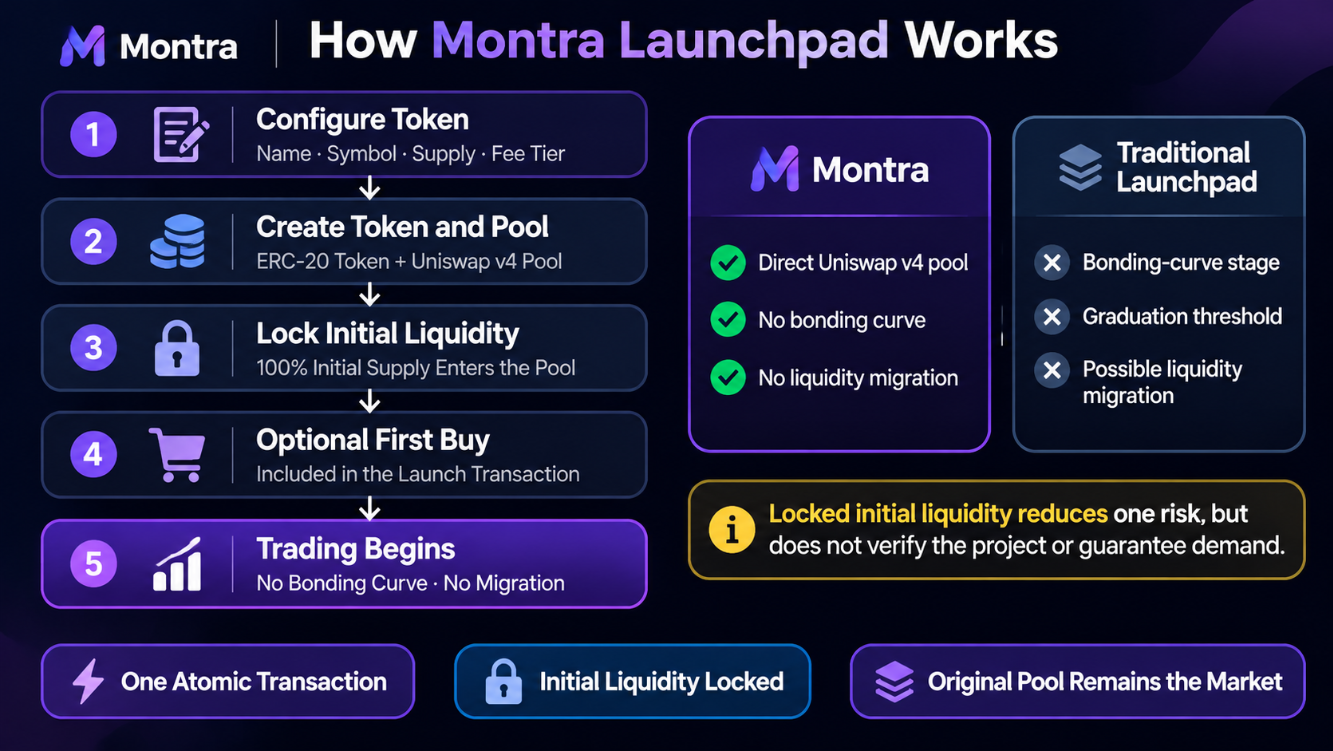
Montra is a permissionless token-launch and trading platform on Elysium that creates ERC-20 tokens and permanent Uniswap v4 pools in one transaction. It is designed to remove the bonding-curve and liquidity-migration stages used by many memecoin launchpads.
A standard Montra launch can include:
- The ERC-20 token.
- Its Uniswap v4 trading pool.
- The initial locked liquidity position.
- The creator’s optional first buy.
All actions are atomic. If one part fails, the full transaction reverts. Users should therefore never encounter a successfully created standard launch token without its intended pool because the token and pool are part of the same transaction.
How does Montra work?
Montra places 100% of the new token’s initial supply into a locked pool position and begins trading in that same pool from the first block. The hook that controls the seed liquidity has no function for withdrawing it, according to Montra’s documentation.
The sequence is:
- The creator selects the name, symbol, image, description and supply.
- The creator selects a quote asset and fee tier.
- The creator selects where the creator-side fee goes.
- The creator can enable an anti-snipe fee and optional first buy.
- One transaction creates the token, pool and locked seed liquidity.
- Trading begins in the original Uniswap v4 pool.
Montra uses “graduation” as a market-value milestone, not a migration event. The pool does not graduate from a bonding curve into a different DEX. It remains the token’s market for its lifetime.
Montra vs a bonding-curve launchpad
Montra begins with a Uniswap v4 pool, while a bonding-curve launchpad initially prices tokens according to a curve and may later migrate liquidity. This changes the operational risks but does not eliminate speculative risk.
With Montra:
- There is no bonding curve.
- There is no required migration.
- The original pool remains active.
- Initial liquidity is locked by the hook.
- Fees and reward routing are configured at launch.
Locked seed liquidity does not prove that a project is legitimate. A token can still have misleading marketing, concentrated buyers, no product, low demand or extreme volatility.
Why does Montra use Uniswap v4?
Uniswap v4 lets Montra attach custom hook logic to pool activity while using a shared PoolManager for swaps and liquidity. Hooks allow Montra to manage fee routing, anti-snipe charges, holder rewards and locked-liquidity behavior.
This flexibility is also a risk. A hook is critical execution code, so an implementation bug could affect trading, fee accounting or liquidity. Users should review audits and contract permissions rather than assuming the Uniswap name guarantees every custom hook.
3. How to Use Montra Launchpad
To use Montra, a beginner needs a compatible self-custody wallet, Elysium added as a network and enough HYPE for gas and trading. Funds should be bridged through official routes before the user connects to Montra.
Step 1: Prepare a wallet and HYPE
MetaMask and Rabby are common EVM-compatible choices. Before funding the wallet:
- Download the wallet only from its official source.
- Back up the recovery phrase offline.
- Never share the phrase with support staff or bridge operators.
- Add Elysium using official network details.
- Verify Chain ID 99901 before signing.
- Keep a small HYPE reserve for gas rather than spending the full balance.
Step 2: Bridge assets to Elysium
The safest default route is to move supported assets into a self-custody wallet, obtain HYPE on HyperEVM if necessary and then use Elysium’s official bridge. Do not send exchange withdrawals directly to a bridge contract unless both services explicitly document that route.
One possible path is:
Exchange or external chain → personal wallet → HyperEVM → Elysium
Before confirming:
- Check the source and destination networks.
- Verify the official bridge domain.
- Confirm the asset and amount.
- Leave enough gas on the source chain.
- Test with a small amount when practical.
- Save the transaction hashes.
Deposits from HyperEVM may complete quickly, but standard withdrawals from Elysium are subject to the optimistic challenge period. A fast deposit does not imply an equally fast native withdrawal.
Step 3: Connect to Montra
Visit Montra’s official website, select Connect Wallet, choose the wallet and confirm that the requested connection is for Elysium. A connection request should not require the recovery phrase or private key.
Phishing risk is unusually high after a new chain or launchpad gains attention. Avoid sponsored search results, private messages and unofficial Telegram links.
Step 4: Research a token before buying
The ticker and image are not sufficient identifiers because anyone can launch a token with the same name. Check the full contract address and pool.
Review:
- Token contract.
- Pair and quote asset.
- Price and market capitalization.
- Pool liquidity and expected price impact.
- Trading volume and number of independent traders.
- Holder distribution.
- Creator or insider wallets.
- Pool fee and anti-snipe settings.
- Whether creator-side fees go to a wallet, split or holders.
Montra’s “new,” “about to graduate” and “graduated” labels help organize launches, but none is a safety rating.
Step 5: Buy a token on Montra
A Montra purchase is a wallet swap through the token’s Uniswap v4 pool. The interface should show the pool fee, anti-snipe effect, estimated output and price impact before signature.
- Select the token from Explore.
- Recheck its full contract address.
- Enter the HYPE or supported quote amount.
- Inspect the fee and minimum output.
- Check price impact and slippage tolerance.
- Confirm that the anti-snipe fee is acceptable.
- Sign the transaction in the wallet.
- Verify the received balance and transaction on the explorer.
Slippage is the permitted difference between quoted and executed output. Price impact is the change caused by the trade itself. A high slippage setting can make execution easier but exposes the user to a worse fill.
Understanding the anti-snipe fee
A Montra pool may charge buys an extra fee immediately after launch, starting as high as 99% and falling linearly to the normal pool fee within the selected window. Sales and the creator’s first buy do not pay this extra charge.
This setting is intended to discourage automated sniping, but it can be extremely expensive for an uninformed buyer. At a 99% fee, a buyer effectively pays roughly 100 times the pool price for the small amount received. Montra asks for additional confirmation when the buy fee exceeds 10%, but the user is responsible for reading it.
Step 6: Track holdings and rewards
Portfolio value should be calculated using an executable selling quote, not only the last traded price. For low-liquidity tokens, the displayed value may be impossible to realize in one transaction.
If a token routes creator-side fees to holders, rewards accrue in the quote asset according to Montra’s holder-reward mechanism. Claiming requires gas. These rewards are token-specific and should not be confused with MONTRA’s protocol buyback.
Step 7: Launch a token on Montra
Anyone can create a standard Montra launch without project approval, which lowers technical barriers but does not create legal, business or investment legitimacy. Creators must consider local laws, disclosure obligations and intellectual-property rights.
The launch form asks for:
- Token name, symbol, image and description.
- Supply from 1 billion to 1 quadrillion whole tokens.
- HYPE or another approved quote asset.
- A 1%, 2%, 3%, 5% or 10% fee tier.
- Creator-share destination: wallet, another address, fixed split or token holders.
- Optional anti-snipe duration.
- Optional first buy.
The name, symbol and metadata are fixed at launch. Standard launched tokens have no owner, no post-launch minting, no transfer tax, no pause and no blacklist. Their supply can only fall. Those constraints reduce some contract-level abuse vectors but do not protect buyers from false claims or market manipulation.
4. How Do Montra Fees and MONTRA Tokenomics Work?
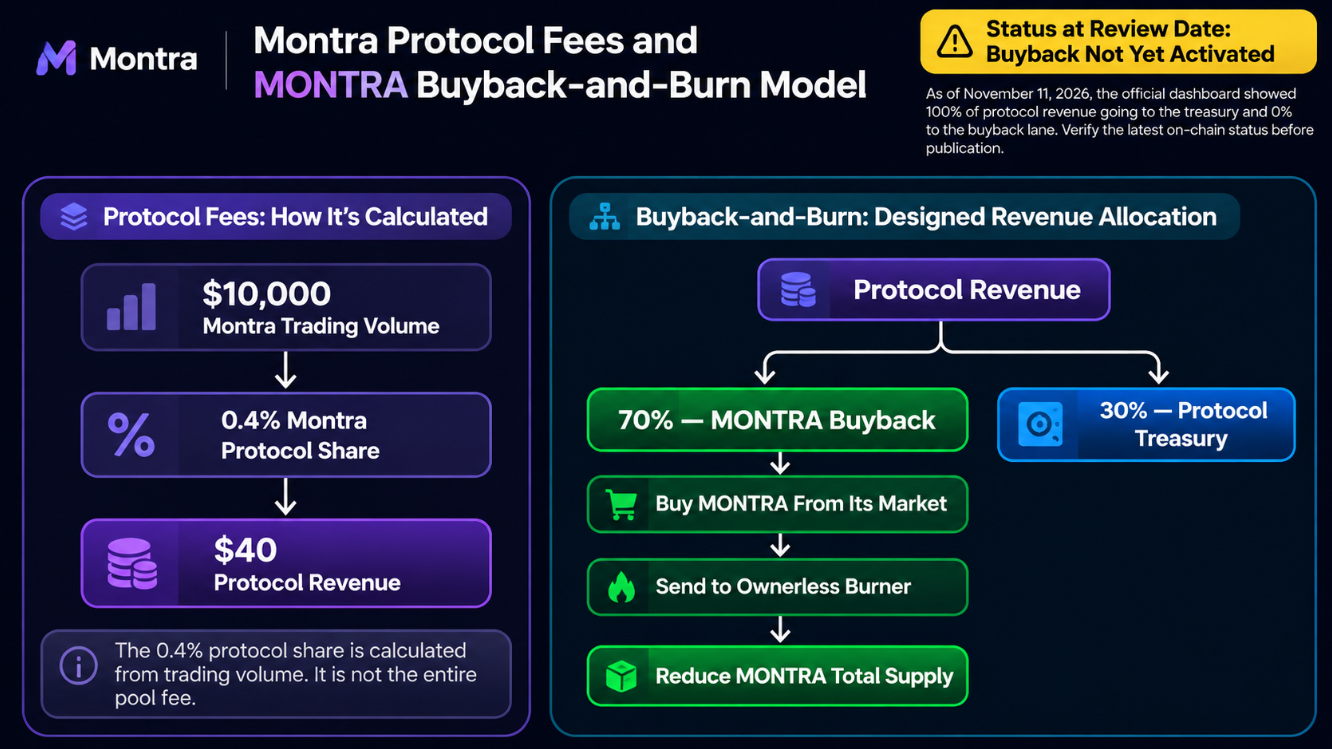
Montra earns a fixed 0.4% protocol share from each launchpad-pool trade, while the remainder of the selected fee goes to the creator side and, after the liquidity milestone, eligible liquidity providers. MONTRA is designed to capture part of that protocol revenue through buybacks and burns.
Montra’s trading-fee structure
Creators select a total fee tier of 1%, 2%, 3%, 5% or 10%. Montra’s protocol component remains 0.4% across the tiers unless lowered under the protocol rules. For example, before the experimental LP line:
- A 1% trade fee contains 0.4% protocol share and 0.6% creator side.
- A 2% trade fee contains 0.4% protocol share and 1.6% creator side.
- A 5% trade fee contains 0.4% protocol share and 4.6% creator side.
After the LP milestone, an experimental pool-liquidity share may apply and the creator-side amount changes. The exact fee card for the pool is therefore more reliable than a generic summary.
The crucial denominator is trade value. If a pool processes $10,000 of volume, a 0.4% protocol share equals $40 before considering collection and conversion mechanics. It does not mean Montra earns 40% or 70% of the $10,000.
What is MONTRA?
MONTRA is the native token of the Montra launchpad and follows the same constrained launch-token design: no owner, no additional minting, no transfer tax and a supply that can only decrease. The team multisig is recorded as its creator for fee-routing and protocol configuration purposes.
The official contract identified by Montra and the Elysium explorer is:
0x063F7Cc5339f92a5FD7BaF3D22233044FdA1F327
This full address matters because the explorer already displays several unrelated tokens using MONTRA-like names. Only the contract marked official by Montra should be treated as the platform token.
On-chain snapshot, November 11, 2026: Elysium’s token explorer reported approximately 991 million MONTRA remaining from an original 1 billion-scale supply and roughly 3,500 holders. These values are highly dynamic and should be rechecked at publication.
How is the MONTRA buyback supposed to work?
Designed Mechanism: after activation, 70% of Montra’s 0.4% protocol fee share buys MONTRA from its own market and sends the purchased tokens to an ownerless burner; the remaining 30% goes to treasury.
The intended flow is:
Montra trading → 0.4% protocol share → 70% buyback lane / 30% treasury → market purchase → MONTRA burn
Using the $10,000 volume example:
- Montra protocol share: $40.
- Intended buyback allocation after activation: $28.
- Treasury allocation after activation: $12.
This is a mathematical example, not a statement about Montra’s actual daily revenue.
Has the MONTRA buyback started?
Current Mechanism at review time: the buyback had not been activated, so 100% of the protocol share still went to treasury and 0% went to the buyback lane. Montra’s official buyback dashboard stated this explicitly and showed no TokenBurner address yet.
This status changes the investment analysis. “MONTRA has a 70% buyback” describes the documented future configuration, not the current cash-flow allocation. Fees collected before activation remain treasury revenue and are not retroactively assigned to buybacks.
The activation sequence requires a burner, a configured buyback lane and an authorized filler that purchases only through the token’s pool. The daily release mechanism is designed to limit how much accumulated buyback value reaches the pool at once. Investors should verify activation through the dashboard, contracts and events rather than relying on social posts.
Can buybacks guarantee a higher MONTRA price?
No. Buybacks create potential market demand and reduce supply only when real revenue exists, activation is complete and purchases are large enough relative to selling pressure and liquidity. Price can still fall.
Track four variables:
- Platform protocol revenue.
- Value allocated to the buyback lane.
- MONTRA actually purchased and burned.
- Circulating supply, holder concentration and market depth.
A high-volume launch week may create temporary fees. Long-term value requires recurring launches and trading after incentives and novelty decline.
5. How Are Elysium, KNTQ and MONTRA Connected?
Elysium is Kinetiq’s network, KNTQ is Kinetiq’s protocol token, and MONTRA is the token of an independent launchpad application built on Elysium. Their revenue sources and buyback denominators are different.
Elysium’s announced sequencer-revenue allocation is:
- 25% for builders whose applications drive network activity.
- 50% for KNTQ market purchases.
- 25% for protocol operations.
Montra’s model applies inside the launchpad:
- 0.4% of each Montra pool trade is the protocol share.
- After activation, 70% of that protocol share is intended for MONTRA buyback and burn.
- The remaining 30% is intended for treasury.
The statement “KNTQ receives 50% and MONTRA receives 70%” is misleading because the denominators differ. KNTQ’s 50% refers to Elysium sequencer revenue. MONTRA’s 70% refers only to Montra’s protocol share of launchpad fees.
For a deeper analysis of Kinetiq’s liquid staking, KIP-5 and Assistance Fund model, see the KNTQ token guide.
6. Where Can You Buy MONTRA?
MONTRA can be bought through its official Montra pool on Elysium and through centralized markets that have opened the token, including HiBT’s announced MONTRA/USDT pair. Every buyer should verify the contract, network and live liquidity before placing an order.
Buying MONTRA on Montra
The native route uses a self-custody wallet and HYPE on Elysium:
- Bridge HYPE to Elysium through the official bridge.
- Connect to Montra’s official website.
- Open the official MONTRA token page.
- Confirm contract
0x063F7Cc5339f92a5FD7BaF3D22233044FdA1F327. - Inspect fee, liquidity, price impact and minimum output.
- Sign the trade and verify the resulting balance on-chain.
This route provides direct on-chain access but exposes users to wallet, bridge, hook, pool and slippage risk.
How to buy MONTRA with USDT on HiBT
HiBT published a MONTRA/USDT listing announcement on November 11, 2026, and its homepage displayed a nonzero MONTRA quote at the review time, indicating that market activity had appeared. Because a listing can open in stages, users should confirm deposits, withdrawals and an executable order book before transferring funds specifically for MONTRA.
- Visit the official HiBT website and create an account.
- Complete any identity checks required for the user’s region.
- Enable two-factor authentication and anti-phishing protections.
- Deposit USDT using a network supported on both sides.
- Open the MONTRA live price and market page.
- Confirm that MONTRA/USDT is open and that bids, asks and recent fills are genuine.
- Select a market order for immediate execution or a limit order for price control.
- Enter the amount, review the fee and estimated quantity, then submit.
- Check the filled amount and average price in order history.
A market order can cross a wide spread in a thin market. New users should prefer a small limit order or test order until liquidity quality is understood.
CEX or on-chain pool: which is better?
A CEX is generally easier for USDT users, while the on-chain pool provides self-custody and transparent contract execution. Neither is automatically safer.
A CEX introduces custody, withdrawal and account-access risks. The on-chain route introduces phishing, network, contract and slippage risks. The best channel is the one the user can verify and operate safely at an acceptable total cost.
7. MONTRA Price Prediction: What Could Drive Future Value?
MONTRA’s price should be modeled from Elysium adoption, Montra launches, sustainable trading volume, protocol revenue, buyback activation, verified burns and liquidity—not from a fixed 2030 target. The token’s short history makes precise long-range forecasts especially unreliable.
Bull case
The bullish scenario requires a complete business flywheel:
More Elysium users → more credible Montra launches → recurring trading → higher protocol revenue → activated buybacks → verified MONTRA burns
It also requires sufficient liquidity for buybacks and outside buyers without extreme price impact. More exchange support can improve access, but listings alone do not create durable demand.
Base case
In the base case, Elysium attracts some applications and Montra remains an active launchpad, but most launches have short lifecycles. Protocol fees occur in bursts, buybacks are modest and MONTRA remains highly sensitive to market sentiment.
Bear case
The bearish scenario is straightforward: new-chain excitement fades, launch quality falls, traders move to competing platforms, volume declines and the buyback remains inactive or economically small. Low liquidity then amplifies selling pressure.
Readers can use the MONTRA price prediction page for scenario exploration, but HiBT notes that predictions incorporate user feedback. It is not a substitute for revenue, supply and liquidity analysis.
How BTC, ETH and HYPE affect MONTRA
BTC and ETH influence broad risk appetite, while HYPE is more directly connected to Elysium’s gas economy and Hyperliquid activity. A sharp market decline can reduce demand for newly launched tokens and cause liquidity to disappear faster than it does in larger assets.
Use Bitcoin price prediction, Ethereum price prediction and the ETH live price as market-context tools—not as direct MONTRA valuation models.
8. Is MONTRA a Good Investment?
MONTRA is a speculative early-stage ecosystem investment, not a proven cash-flow asset; it becomes more investable only when Montra demonstrates repeat usage and activates a verifiable revenue-funded burn. The current thesis depends heavily on future execution.
My six-part test is:
- Elysium adoption: Are active addresses, transactions and useful applications growing after launch week?
- Launchpad quality: Are credible teams launching, or is volume concentrated in disposable copy tokens?
- Recurring volume: Does activity persist beyond the first few days?
- Protocol revenue: Is the 0.4% protocol share producing meaningful value?
- Buyback execution: Has the 70% lane been activated, and can purchases and burns be verified?
- Valuation and liquidity: Does the market price already assume a dominant launchpad position?
At the review date, the unactivated buyback is the most important limitation. Investors are paying for the expectation that the mechanism will turn on and matter economically.
Short-term strategy
Short-term traders should watch:
- One-hour and four-hour trend structure.
- Spot volume and independent trader count.
- Bid-ask spread and sell-side depth.
- Pool price impact for the intended order size.
- Large-holder transfers.
- Buyback-activation announcements and on-chain confirmation.
Do not chase a large percentage gain without measuring exit liquidity. A token can display a multi-million-dollar market capitalization while only a small amount is available near the quoted price.
Medium-term strategy
A one-to-three-month investor should track weekly launches, repeat traders, protocol revenue, the buyback dashboard, total burned supply and the share of volume captured by a few tokens.
Use staged entries rather than one purchase:
- Observation position after identity and liquidity checks.
- Confirmation position only after revenue persists.
- Additional exposure only after buyback activation is verified and market depth improves.
If the business metrics weaken, do not convert a failed medium-term thesis into an indefinite long-term hold.
Long-term strategy
A six-to-24-month thesis requires Montra to become durable Elysium infrastructure rather than a launch-week application. The platform must retain creators and traders, integrate with wallets or terminals, sustain safe contracts and create enough protocol revenue for burns to matter.
Long-term holders should compare MONTRA’s burned value with its market capitalization. A burn can sound impressive in token units while being economically insignificant in dollar terms.
Position sizing and risk limits
MONTRA should be treated as a satellite allocation. A portfolio containing BTC, ETH and MONTRA does not become diversified merely because it has three tickers; all remain exposed to crypto liquidity and risk sentiment.
Determine size from maximum acceptable loss:
Position Size = Maximum Acceptable Loss ÷ Planned Loss Percentage
If the maximum tolerable loss is $20 and the planned risk is 20%, the theoretical position is $100. Reduce it further when liquidity is weak because actual slippage can exceed the planned loss.
Avoid leverage. Do not use living expenses, debt or emergency savings for a newly launched ecosystem token.
9. Elysium and Montra Competitive Landscape
Elysium’s advantage is its connection to Hyperliquid markets and dedicated execution, while Montra’s advantage is a simple atomic launch into permanent Uniswap v4 liquidity. Both still need to prove distribution, security and sustained activity.
Montra competes on:
- One-transaction launches.
- No migration risk between a curve and DEX.
- Locked initial liquidity.
- Flexible creator, split and holder-reward routing.
- Configurable anti-snipe fees.
- Standard EVM composability.
Its disadvantages include a very new network, limited cross-application liquidity, bridge friction and strong competition from established launchpads on Solana, Base, BNB Chain and other EVM networks.
A technically cleaner launch mechanism does not guarantee market leadership. Distribution, wallet integrations, creator quality, liquidity and user retention matter more than feature count.
10. Risks of Using Montra and Investing in MONTRA
The largest risks are early-network concentration, smart-contract failure, malicious token creators, low liquidity, same-name counterfeit tokens and an unactivated buyback mechanism. Each risk should be checked separately.
Elysium network risk
The network had only just launched when reviewed. A single sequencer can become an availability or ordering bottleneck. AnyTrust depends on its data-availability assumptions, and the native withdrawal delay can trap capital for several days during stress.
Bridge and withdrawal risk
Bridges hold or transmit significant value and are frequent attack targets. A fast bridge adds liquidity-provider and contract risk. Always test routes with a small amount and use official interfaces.
Smart-contract and hook risk
Montra’s custom Uniswap v4 hook controls fee and liquidity behavior. A bug in the hook, router, fee vault, keeper or burner could affect trades or accounting. Published source code and audits reduce uncertainty but cannot eliminate exploits.
Rug-pull and misinformation risk
Locked initial liquidity and no mint function do not validate a token’s story. Creators can publish false claims, coordinate wallets, buy early and sell into later users. Intellectual-property-themed tokens may have no relationship to the referenced brand.
Anti-snipe fee risk
A buyer who ignores the fee may receive a tiny fraction of the expected tokens. The fee can begin at 99%. Always review the effective price before signing.
MONTRA-specific risk
The token is easy to impersonate. The official contract must be verified. At the review time, the buyback had not started, so investors should not value MONTRA as if ongoing burns were already proven.
Safety checklist
- Use only
https://montraxyz.com/and official Elysium links. - Verify Elysium Chain ID 99901.
- Keep enough HYPE for gas.
- Confirm the complete token and pool contracts.
- Verify MONTRA as
0x063F7Cc5339f92a5FD7BaF3D22233044FdA1F327. - Read the pool fee and anti-snipe cost.
- Check liquidity, holder concentration and creator wallets.
- Review the minimum received amount.
- Understand the native withdrawal delay.
- Verify buyback activation and burns on-chain.
11. Final Verdict: Is Montra Worth Exploring in 2026?
Montra is worth exploring as an early Elysium application, but MONTRA is not yet proven as a long-term investment. The launchpad offers a coherent product: atomic issuance, locked seed liquidity, permanent Uniswap v4 markets and configurable fee routing. Elysium also provides an interesting execution environment connected to Hyperliquid.
The token thesis is less mature than the product thesis. MONTRA’s 70% buyback-and-burn design could create value capture, but the official dashboard showed the mechanism was not activated at the review time. Until recurring revenue, live buybacks and burns are visible, investors are mainly buying an expectation.
My conclusion is clear:
- For users: Montra is useful to study and test with small amounts after bridge and fee checks.
- For creators: it offers a simpler permanent-pool launch model, but legal and reputational duties remain.
- For short-term traders: liquidity and anti-snipe fees matter more than the headline market cap.
- For long-term investors: wait for evidence of sustained launches, protocol revenue and verifiable buyback execution.
The strongest investment sequence is not “new chain → new launchpad → token must rise.” It is:
Elysium retains users → Montra retains creators and traders → fees become recurring revenue → buybacks activate → burns are verified → liquidity remains healthy
If any link fails, the valuation should be reduced.
12. Frequently Asked Questions About Elysium and Montra
The following answers summarize Elysium’s architecture, Montra’s launch model and the key requirements for buying or evaluating MONTRA.
What is Elysium?
Elysium is a Kinetiq-developed Arbitrum Orbit Layer 2 that settles on HyperEVM. It uses HYPE for gas and is configured for high-frequency DeFi and trading applications.
Who built Elysium?
Kinetiq developed Elysium using the Arbitrum platform. Kinetiq is also known for kHYPE liquid staking and the KNTQ governance token.
Is Elysium an Ethereum Layer 2?
Elysium uses Arbitrum Layer 2 technology but settles on HyperEVM rather than Ethereum L1. It belongs economically and operationally to the Hyperliquid ecosystem.
What is Elysium’s gas token?
HYPE is the native gas token. Users need HYPE on Elysium to pay for swaps, launches, reward claims and other transactions.
What is Montra Launchpad?
Montra is a permissionless token launch and trading venue on Elysium. It creates a standard ERC-20 token, Uniswap v4 pool and locked initial liquidity in one transaction.
How does Montra differ from Pump.fun?
Montra does not begin with a bonding curve and does not migrate liquidity after graduation. The initial Uniswap v4 pool remains the token’s market.
Can anyone launch a token on Montra?
Yes, standard launches are permissionless. This does not exempt creators from laws or make every launched token legitimate, safe or valuable.
How do I bridge assets to Elysium?
Use Elysium’s official bridge and supported routes. Obtain HYPE in a self-custody wallet, verify source and destination networks and retain gas on both sides.
What is MONTRA crypto?
MONTRA is Montra’s native launchpad token. It has no post-launch minting or transfer tax, and its designed buyback mechanism can reduce supply after activation.
What is the official MONTRA contract?
The official Elysium contract is 0x063F7Cc5339f92a5FD7BaF3D22233044FdA1F327. Same-name tokens are not automatically official.
Does MONTRA have a buyback and burn?
Its documented design assigns 70% of Montra’s protocol fee share to buybacks and burns after activation. At the November 11, 2026 review time, the official dashboard said the mechanism was not yet switched on.
Where can I buy MONTRA?
Users can trade the official MONTRA pool on Montra using HYPE. HiBT also announced MONTRA/USDT and displayed a live quote, but users should verify market depth and account availability before buying.
Sources and Verification Labels
- Elysium mainnet announcement — Officially Announced architecture and performance targets.
- Elysium official documentation — official network configuration, bridge and security model.
- Montra documentation — Officially Announced launch, pool and token design.
- Montra fee documentation — official fee tiers, protocol share and anti-snipe rules.
- MONTRA documentation — official token identity and designed buyback allocation.
- Montra buyback dashboard — On-chain Derived current allocation, activation and burn data.
- Elysium token explorer — On-chain Reported holder and supply snapshots.
- HiBT’s November 11, 2026 MONTRA listing announcement and MONTRA market page — exchange support and market entry point.